
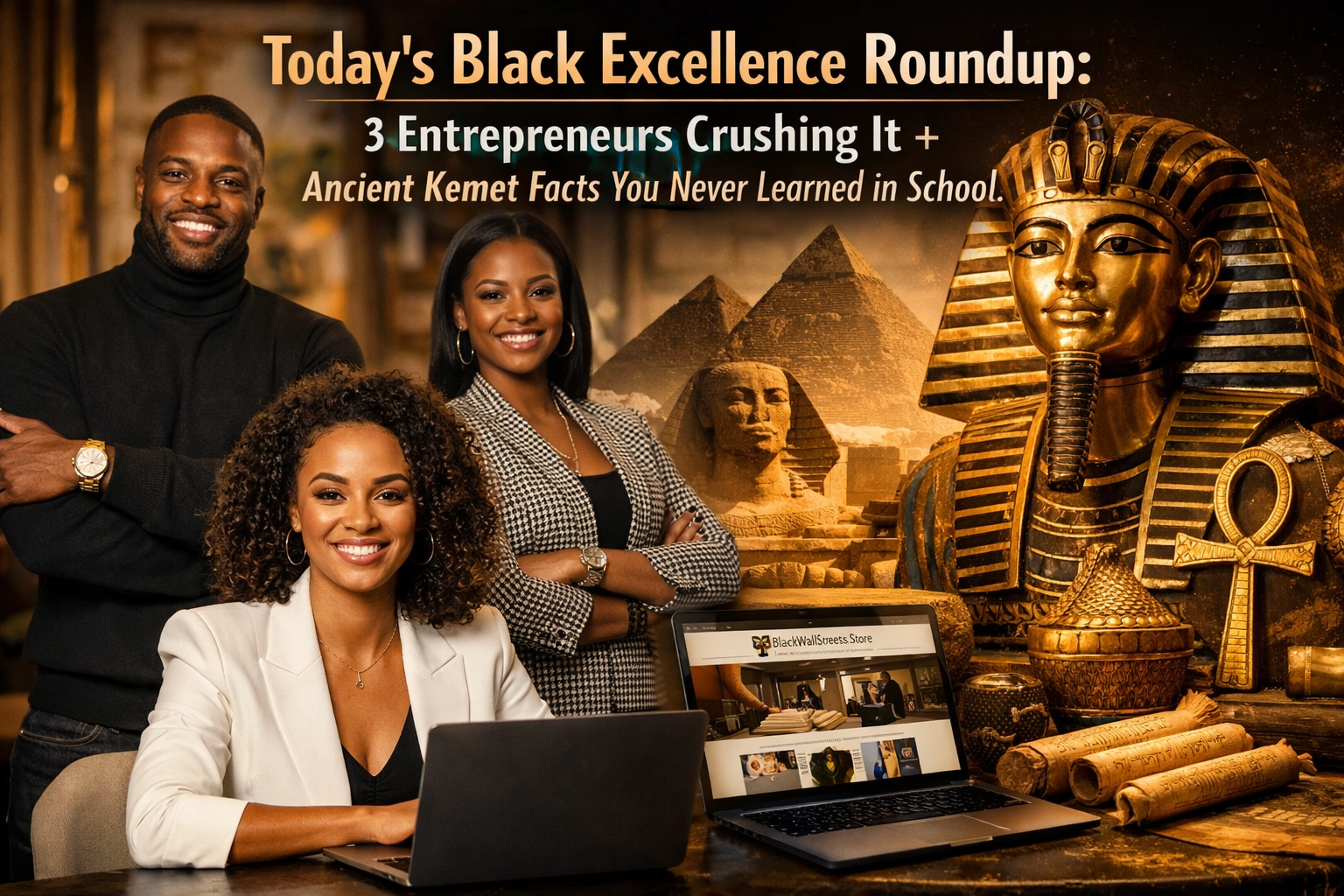
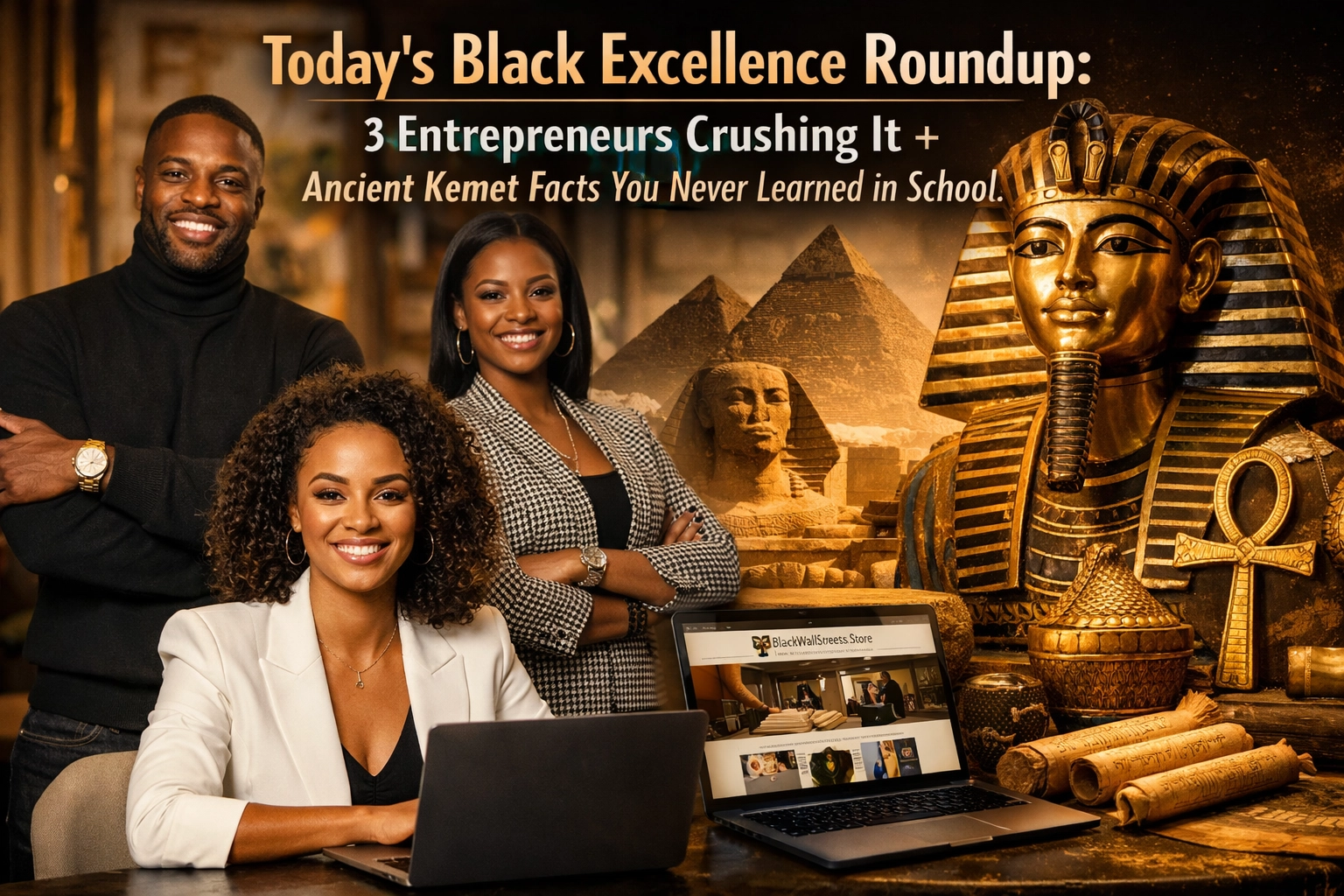
Today's Black Excellence Roundup: 3 Entrepreneurs Crushing It + Ancient Kemet Facts You Never Learned in School

Welcome to your Tuesday dose of Black excellence! ☀️
If you've been doomscrolling through the same recycled headlines, it's time to hit refresh. Today, we're shining a spotlight on three entrepreneurs who are not just building businesses, they're rewriting entire industries. Plus, we're diving into some mind-blowing Ancient Kemet facts that somehow never made it into your high school history book (go figure).
Let's get into it.
1. Pinky Cole: Making Vegan Fast Food a Whole Vibe

If you haven't heard of Slutty Vegan, where have you been? Pinky Cole turned the plant-based food game on its head, and she did it with swagger, flavor, and unapologetic Blackness.
Starting from her Atlanta headquarters, Cole has been expanding her vegan empire across the United States, proving that plant-based doesn't have to mean bland or boring. Her menu features outrageously named burgers like the "One Night Stand" and "Fussy Hussy," and people are lining up around the block for them.
But here's what makes Pinky's story so powerful: she's not just serving food, she's serving culture. She's showing the world that vegan fast food can be mainstream, delicious, and rooted in Black culinary tradition. In a food industry that's historically excluded Black entrepreneurs, especially Black women, Cole is claiming her space and making it impossible to ignore.
The lesson? Don't wait for a seat at the table. Build your own damn restaurant.
2. Morgan DeBaun: Building Media That Actually Gets Us
Remember when mainstream media would try to cover "what millennials want" and completely miss the mark for Black millennials? Yeah, Morgan DeBaun noticed that too, and she did something about it.
As the founder and CEO of Blavity, DeBaun built a digital media powerhouse that speaks directly to Black millennials and Gen Z. The company has raised $9.4 million in funding from heavy hitters like GV, 500 Startups, and Harlem Capital Ventures.
Here's why this matters: DeBaun recognized a gap in the market that others either couldn't see or didn't care about. Black millennials weren't being served by traditional media outlets, so she created Blavity to deliver culturally relevant content that actually resonates.

Today, Blavity isn't just a blog, it's a multi-platform media company covering news, culture, lifestyle, and more. It's proof that when you create something authentic for your community, success follows.
The bigger picture? Representation isn't just about who's in front of the camera, it's about who's behind it, making decisions, and controlling the narrative. That's power.
3. Diishan Imira: Solving Real Problems in Black Beauty
Let's talk about Mayvenn and its co-founder Diishan Imira, who raised $36 million to solve a problem that most people didn't even know existed.
Here's the thing: 95% of African American salons couldn't access the hair products their customers actually wanted. Wild, right? In an industry built on Black women's spending power, the supply chain was completely broken.
Imira co-founded Mayvenn in 2012 to fix this exact gap, creating a platform that streamlines product sales in salon settings. The company connects stylists directly with the products they need, cutting out unnecessary middlemen and putting money back into Black hands.
This is the kind of innovation that doesn't just create wealth, it redistributes it back into our communities. When Black entrepreneurs solve problems for Black consumers, everybody wins.
Ancient Kemet: The History They Didn't Teach You

Alright, let's switch gears and travel back about 5,000 years. We're talking about Ancient Kemet: what we now call Egypt: and all the incredible innovations that came from African minds long before colonization tried to erase them from history.
Did you know? The Ancient Kemetic people invented one of the earliest writing systems in human history. Hieroglyphics weren't just pretty pictures: they were a sophisticated language system used for everything from religious texts to business transactions. While much of the world was still nomadic, Kemet had libraries, schools, and a postal system.
Mathematics and architecture? Kemet wrote the book. The Great Pyramid of Giza, built around 2560 BCE, was the tallest man-made structure in the world for over 3,800 years. Let that sink in. The precision required to build these monuments: aligned with astronomical events and constructed without modern technology: still baffles engineers today.
Medicine and surgery? Kemetic physicians were performing complex surgeries, setting broken bones, and treating diseases while documenting their procedures in medical texts. The Edwin Smith Papyrus, dating back to around 1600 BCE, is one of the oldest known surgical documents and shows detailed knowledge of the human body, including the brain and heart.
Here's the part they really don't tell you: Ancient Kemet was a Black African civilization. The Nile Valley civilization was built by Black Africans who created systems of governance, spirituality, science, and art that influenced the entire ancient world: including Greece and Rome.
Why does this matter today? Because knowing where we come from changes how we see where we're going.
Connecting the Dots: From Ancient Kemet to Modern Excellence

So what do Pinky Cole, Morgan DeBaun, Diishan Imira, and Ancient Kemet have in common?
Innovation born from necessity. Excellence despite the odds. A refusal to wait for permission.
The same brilliance that built pyramids, created written language, and advanced medicine thousands of years ago is the same brilliance creating billion-dollar businesses today. It's not new: it's ancestral.
At The Black Wall Streets, we're not just celebrating these stories: we're actively creating the infrastructure to support them. Our marketplace exists because we know that Black economic power isn't just about individual success; it's about building ecosystems where our businesses, entrepreneurs, and communities can thrive together.
Every purchase you make, every vendor you support, every connection you create through our platform is a modern-day act of resistance and resilience. We're not asking for a seat at anyone's table. We're building our own marketplace, just like our ancestors built entire civilizations.
Why This Matters Right Now
According to data from Black demographics research, Black spending power in the United States exceeds $1.6 trillion annually. Yet only 2% of that money circulates within Black communities before leaving.
Imagine if we changed that number. Imagine if entrepreneurs like Pinky, Morgan, and Diishan became the norm rather than the exception. Imagine if every young Black kid grew up learning about the mathematical genius of Ancient Kemet alongside the business acumen of modern Black entrepreneurs.
That's the world we're building at The Black Wall Streets: one purchase, one story, one connection at a time.
Your Move

Excellence isn't a fluke. It's not luck. It's legacy.
Whether you're building a business, supporting Black-owned brands, or simply learning more about our true history, you're part of this movement. The entrepreneurs crushing it today are standing on the shoulders of Ancient Kemetic giants: and the next generation will stand on ours.
So here's the question: What are you building? What are you supporting? How are you contributing to the economic renaissance happening right now in Black communities across the globe?
The Black Wall Streets marketplace is here to connect you with hundreds of Black-owned businesses ready to serve you. From fashion to home goods, tech to wellness: we've got it all, and it's all us.
Check out our marketplace at blackwallstreets.store and see what excellence looks like when we support each other.
Because at the end of the day, this isn't just about buying Black: it's about building Black. And that legacy? That's forever.
Drop a comment below: Which entrepreneur's story resonated with you most? Or what's one Ancient Kemet fact that blew your mind? Let's keep this conversation going. 👇🏾